Conversion optimisation: winning tests for travel, SaaS and pharmacy
As Conversion Optimisation Manager at Conversion.com in London, owned the testing strategy for Alpharooms, Wistia, DrEd and Just Eat: research into why visitors don't buy, test concepts ranked by impact, and winners of up to 25% more conversions at more than 99% confidence.
My contribution
Owned the optimisation strategy for each client as lead consultant. Chose where to test from traffic, conversion and bounce data, ran the quantitative and qualitative research behind every concept, ranked ideas by impact and ease, wrote the hypotheses, wireframes and copy, managed the designer and developer, and analysed every split test to more than 99% confidence before feeding the learnings back into the strategy.
 Open full-size image ↗
Situation
Conversion.com runs A/B testing programmes for online businesses. My clients were Alpharooms (travel), Wistia (video marketing platform), DrEd (online pharmacy) and Just Eat (food delivery). Each had traffic and a clear goal, a booking, a sign-up or an order, but no shared view of why most visitors left without converting.
Task
Own the optimisation strategy for each client, deliver the highest possible test impact and return, and ship every test on time.
Action
Architecture
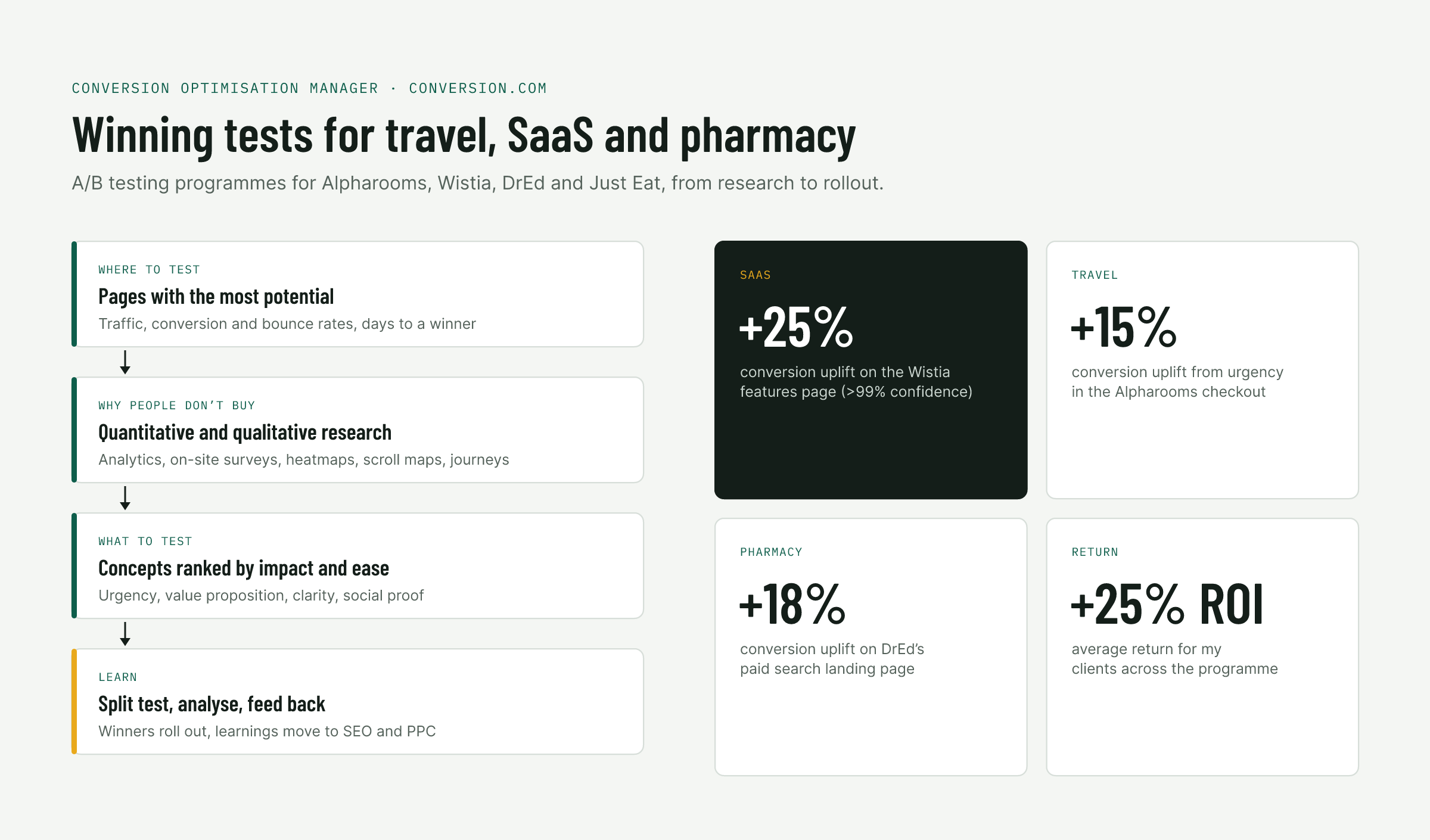
Where to test first. The client named the area and the main KPIs. We then ranked pages by their potential, using traffic, conversion rate, bounce rate and the number of days a test would need to find a winner, and picked the segment to start with, such as landing pages or new versus returning users.
What to test. Quantitative and qualitative research found the barriers, motivations and opportunities behind each page: Google Analytics, on-site surveys, customer surveys, heatmaps, scroll maps and journey analysis for every user type. The findings became conversion levers, such as urgency, value proposition, clarity and social proof, ranked by potential impact and ease.
A continuous loop. Every result, winner or not, updated the strategy, so the programme moved towards what worked and passed the learnings on to other channels.
Implementation
- Concepts and execution. I wrote the hypotheses, drew the wireframes and wrote the copy for each new version, after checking similar tests in our own library and how competitors handled the same problem.
- Delivery on time. A test backlog in Trello, an optimisation roadmap, weekly client meetings, design and development coordinated in Asana, and agile rituals: stand-ups, test kick-offs and retrospectives.
- Client moments. When a client stopped responding, I escalated early so the test calendar held. When a client disagreed with a concept, I backed it with data and kept a plan B with impact ready. When Wistia planned changes to a page under test, we reworked the concept and design to include them.
Verification
- Every test ran as a split test to more than 99% statistical confidence before it was called a winner.
Result
| Test | Client | Change | Result |
|---|---|---|---|
| Urgency in checkout | Alpharooms | A 15-minute price lock with a countdown from the moment a room is selected, for price-sensitive users in peak season | +15% conversion |
| Value proposition | Alpharooms | Clear value propositions in strategic places on the page | +10% conversion |
| Top features first | Wistia | The main features replace the video at the top of the features page, where fewer than half of visitors scrolled | +25% conversion |
| Call to action copy | Wistia | "Sign up" becomes "Start free trial" on the pricing page, after surveys showed users missed the free trial | +20% conversion |
| Landing page simplicity | DrEd | The paid search landing page reduced to two routes: "I am new" and "I am returning" | +18% conversion |
- +25% average return for my clients across the programme.
- Every result above reached more than 99% confidence.
Skills evidenced
- Conversion research: analytics, surveys, heatmaps and journey analysis to find why visitors don't buy.
- Experiment design and statistics: hypotheses, prioritisation by impact and ease, split tests to significance.
- UX and copy: wireframes and copy for every variation.
- Client and delivery management: strategy ownership, escalation and an on-time test calendar.
Portable lessons
- Test where the traffic and the drop-off are. A great idea on a quiet page takes months to prove.
- Ask visitors before guessing. Two of the biggest winners came straight from survey answers and scroll maps.
- Small words move numbers. "Start free trial" beat "Sign up" by 20%.
Want to discuss the decisions behind it?
Over fifteen years of consulting and growth, and hands-on AI delivery from discovery to daily operations. I can share my CV and talk through how I connect business outcomes with systems that run.
Available for a chat. In person in Stavanger, or remotely worldwide.