AI opportunity workshops and automated reports
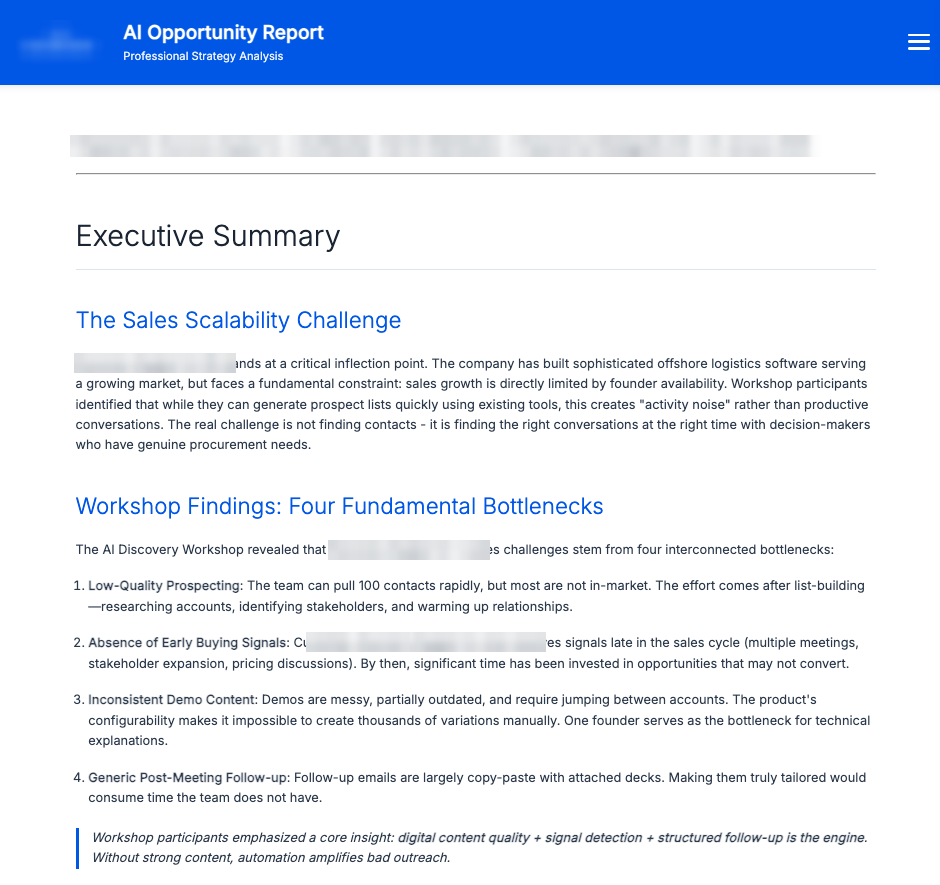
Designed the AI opportunity workshop and automated the report that comes out of it: bottlenecks mapped with the leadership team, use cases prioritised by return and feasibility, ROI cases and a roadmap, published per client and linked to working prototypes.
My contribution
Designed the workshop structure and materials, ran the workshops with leadership teams, implemented the automated report generation and its publishing flow, and turned the strongest opportunities into working prototypes.
 Open full-size image ↗
Situation
Leaders of industrial, energy and service SMBs know AI matters but not where it pays off in their own workflows. In KI-360 sessions for Validé cohorts and in client workshops, the same two questions came up every time: where do we start, and what is it worth?
Discovery work used to end in a one-off deck that took days to write. By the time it arrived, the energy from the workshop was gone and the decision slipped.
Task
Turn a half-day workshop into a prioritised, costed plan fast enough that the leadership team decides while the conversation is still fresh, and make the top recommendation concrete enough to test.
Action
Architecture
One workshop structure, two formats. "Transforming your business with AI" covers blockers, business model, AI strategy and next steps. "AI opportunity discovery" maps the real workflows and finds the best opportunities in them. Both capture findings in the same structure.
The report is generated, not written. Workshop notes and intake answers feed a generator that produces a client-specific report: an executive summary, the bottlenecks behind the challenge, use cases prioritised by return and feasibility, ROI cases and a roadmap from quick improvements to custom builds.
Reports live in the portal. Each report is a managed record with autosaved drafts, reviewed before it is published to the client on stratas.no.
Recommendations become prototypes. The top use cases are built as working prototypes on the client's own data. For an offshore services supplier, three prototypes ran live against Claude, grounded in the client's real product catalogue: AI-assisted quotes with PDF export, a sales-to-operations handover pack with confidence flags, and a prioritised follow-up queue with drafted outreach.
Implementation
- Workshop flow, facilitation material and participant intake.
- Report generator with a fixed section structure and client-specific content.
- Publishing flow through the client portal, with review before release.
- Prototype builds on the client's own catalogue and documents, with structured model output and prompt caching.
Verification
- Every report is reviewed before it is published to the client.
- Prototypes run on the client's own catalogue, so the leadership team can judge the output themselves.
Result
- Reports generated from the workshop data, reviewed and published, instead of written from scratch over several days.
- Decisions made in the room that matters: the leadership team sees its own bottlenecks, ranked, with a prototype of the first fix.
- Engagements that continue: several workshops led to custom builds and to fractional AI leadership one to two days a week.
What I would do differently: ask for historical examples of the outcome the client wants (won deals, good quotes, qualified leads) at the workshop itself. They make the ROI case sharper and the first prototype easier to judge.
Skills evidenced
- Workshop facilitation with leadership teams: bottleneck mapping and use-case prioritisation by return and feasibility.
- Business cases and ROI: costed recommendations and roadmaps from quick wins to custom builds.
- Automated document generation: a fixed report structure filled from workshop data, reviewed and published.
- Rapid prototyping on client data: three working prototypes grounded in a real product catalogue.
Portable lessons
- A prototype on the client's own catalogue does more for a decision than any slide about potential.
- Generate the report while the workshop is still fresh. Speed is part of the value, not a convenience.
- Rank by return and feasibility together. The most valuable idea is rarely the first one to build.
Want to discuss the decisions behind it?
Over fifteen years of consulting and growth, and hands-on AI delivery from discovery to daily operations. I can share my CV and talk through how I connect business outcomes with systems that run.
Available for a chat. In person in Stavanger, or remotely worldwide.